Pasta Machine
- 3.3
- Rating
- 1.00M
- Installs
- Free
- Price

 Analysis by App-foxy
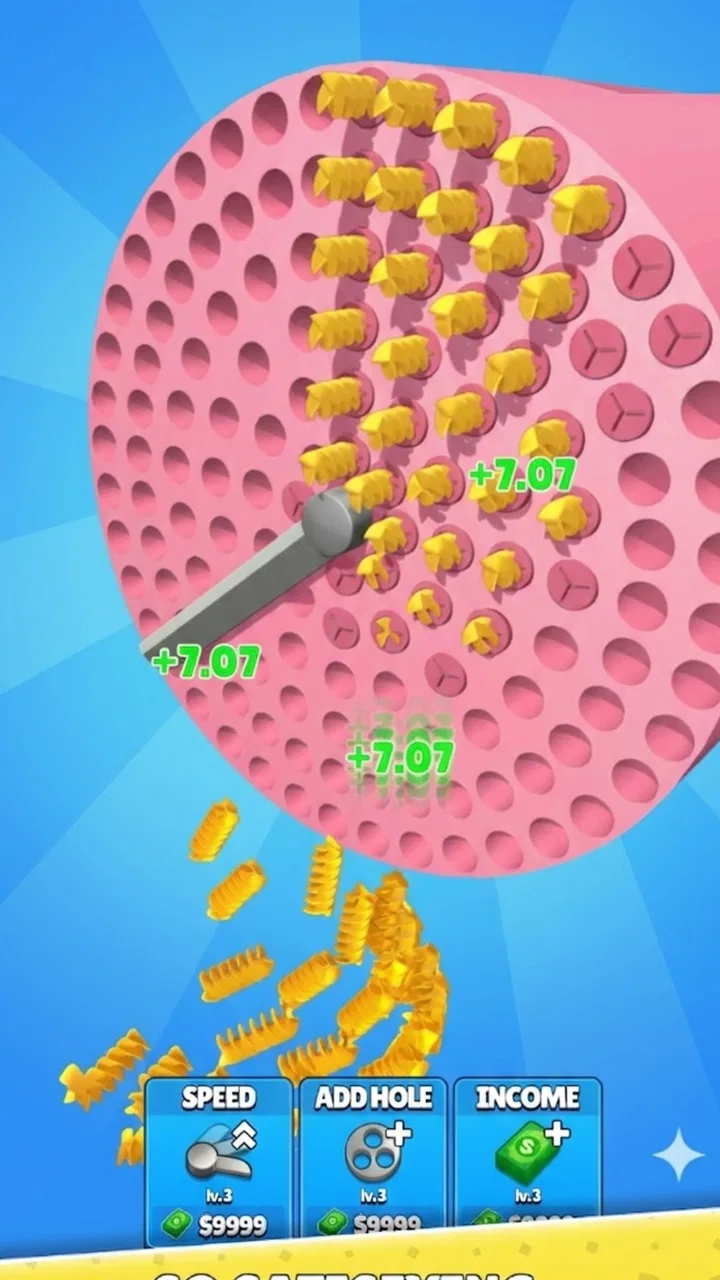
I did not expect a game about cutting pasta to hold my attention for long, but Pasta Machine understands the appeal of a tiny, repeatable task. You see the pasta, make your cut, receive immediate feedback, and then get another chance to improve the result. That simple sequence is the entire attraction, and it works best when I want something light rather than a game that demands planning, story, or a long commitment.
This is a free arcade game from Lumos Games Teknoloji Yazılım Ve Pazarlama A.Ş. It is aimed at Everyone, runs on Android versions starting with 7.0, and has reached over a million installs. The current version is 2.4.0. Those details make its role fairly clear: this is an accessible pick-up-and-play title, not a deep cooking simulator. I would recommend it to someone who enjoys quick tactile challenges, while warning anyone looking for a substantial progression system that the basic idea can become familiar quickly.
Why the first cut matters
The first action is immediately understandable. Pasta appears in front of you and the goal is to cut it quickly. There is no complicated recipe to learn and no long tutorial standing between you and the central interaction. That directness is one of the strongest parts of the design because I can open the game during a short break and know what I am supposed to do within moments.
You May Also Like

 Blood Strike: 2.5 Anniversary
Blood Strike’s Loadouts Turn Every Drop Into a Tactical Gamble
A close look at Blood Strike’s custom loadouts: how fast access to signature weapons reshapes its battle royale rhythm, rewards preparation, and narrows the gap between fights.

 Pandora - Music & Podcasts
Pandora’s Music Is Easy to Start, but Harder to Recover
Pandora’s strength is its low-effort path from a seed to a station. Its weak spot is how much confidence it asks you to place in connection, setup, and quiet recovery.

 8 Ball Pool
 Is Built on Rivalries, Rematches, and Routine
A close look at the rivalries, rematches, shared routines, and unanswered safety questions that turn a quick pool match into a persistent mobile community.

 Samsung Music
’s Quiet Strength Is Playing What You Already Own
Its reach comes less from spectacle than from dependable access to a personal library. That simplicity is both the app’s strongest retention engine and its ceiling.

 AccuWeather: Weather Radar
AccuWeather Review: A Quick, Clear Forecast for Everyday Decisions
For everyday plans, the best forecast is the one you can understand quickly. AccuWeather makes rain timing, radar, and local conditions easy to act on, with a few trade-offs.

 Hill Climb Racing
Why Hill Climb Racing Still Turns Crashes Into One More Run
A tiny car, a bumpy hill and one more upgrade: Hill Climb Racing keeps resurfacing because its simple chaos makes every near-miss feel personal.
More From Our News Desk



What makes the action satisfying is the contrast between a soft-looking food item and the precision expected from the player. The game turns an ordinary kitchen task into a small test of timing and control. I am not managing ingredients, choosing sauces, or building a restaurant. I am concentrating on the cut itself, which keeps the mental load low and makes the game easy to share with someone who normally avoids games.
That simplicity also creates the first important trade-off. If you want a game with several interacting systems, this will feel narrow. The appeal depends on whether the act of cutting is enough to make you try again. For me, it is most enjoyable when I treat it as a short reflex exercise rather than expecting a full culinary experience.
A useful way to play is to avoid rushing blindly on the opening attempt. I first watch how the pasta is positioned and use that round to understand the visual timing. On later attempts, I focus less on speed alone and more on making a clean, deliberate movement. That small change helps because frantic tapping can make the action feel less controlled, even though the game encourages fast cutting.
The feedback rhythm keeps the task alive
The game’s feedback arrives close to the action, which gives each attempt a clear rhythm: approach the pasta, cut, see the outcome, and decide whether the next try can be better. This is the part that turns a basic mechanic into an arcade loop. Without immediate confirmation, cutting pasta would feel like a repetitive gesture. With it, each result becomes a quick piece of information.
I found that the rhythm works particularly well when I have only a minute or two. During a coffee break, I can play a round without needing to remember a story objective or reconstruct a complicated strategy. The game asks for attention in short bursts, then lets me stop. That makes it more convenient than many arcade alternatives that depend on longer runs or several minutes of uninterrupted concentration.
The feedback is also useful for self-correction. If my cut is messy or poorly timed, I can change the next attempt immediately instead of waiting through a long level. This creates a compact learning cycle. I notice what went wrong, adjust my movement, and test the adjustment while the idea is still fresh.
There is a limit, though. A feedback loop can only remain exciting if the player feels that improvement is possible and meaningful. Once I understand the basic timing, the experience relies heavily on personal tolerance for repetition. Players who enjoy chasing a cleaner result may stay engaged longer; players who need new rules, environments, or objectives may feel that the same gesture stops developing soon enough.
Compared with a traditional endless runner, the game is less about steering through a changing space and more about perfecting one focused action. Compared with a match-three title, it offers less planning and fewer layered decisions. Its advantage is immediacy. Its weakness is that it does not provide the same variety those alternatives use to refresh the experience.
What the reward loop gives you
After the cut, the result acts as the short-term reward. The satisfaction is not only in finishing the action but in seeing whether the attempt looked or performed better than the previous one. That gives the game a modest sense of progress even when I am playing for only a few moments.
I would describe the reward as skill-based motivation rather than a rich collection-based system. The main question in my mind is, “Can I do that more cleanly or more quickly next time?” This is a good fit for people who like repeating a small challenge until their hands feel more confident. It is less suitable for anyone who expects a large inventory, a narrative payoff, or a detailed kitchen to develop over time.
The free entry point makes experimenting easy. I do not need to commit money before finding out whether the cutting mechanic suits me. The game does include in-app purchases ranging from $1.99 to $99.99 per item, so I would approach any optional spending carefully and decide first whether the basic loop genuinely has lasting value for me. For a short arcade distraction, I would personally keep the initial session focused on the free experience rather than treating purchases as part of the reason to play.
One practical tip is to judge the game by the quality of your own short sessions, not by how long you can force yourself to continue. If the first few attempts make you want to refine your timing, the reward is doing its job. If you are already looking for a different mechanic after a handful of cuts, extra time or spending is unlikely to solve the underlying mismatch. That is a better test than assuming every arcade game needs to become a daily habit.
The average rating is 3.3 from around twelve thousand ratings, with hundreds of written reviews. I read that as a sign that the concept has clear appeal but is not universally satisfying. My experience fits that middle ground: the interaction is easy to understand and pleasantly immediate, yet its limited premise will naturally divide players according to how much repetition they enjoy.
Why another session begins
The reset is almost as important as the cut. Once an attempt ends, the game gives me a clean opportunity to try again instead of making the previous result feel final. That restart is what keeps the loop moving: action produces feedback, feedback suggests an adjustment, and the reset removes the cost of experimenting.
This structure works well for casual use because failure does not require a large recovery period. I can make a poor cut, understand that it was poor, and immediately attempt a different approach. In a more elaborate arcade game, a failed run may mean repeating a long opening section. Here, the short reset makes mistakes feel less irritating.
At the same time, fast resets can encourage automatic play. I sometimes found myself beginning another attempt before thinking about why the previous one had gone wrong. The better habit is to pause for a second, identify whether the problem was speed, positioning, or a rushed movement, and then restart with one specific adjustment. That turns repetition into practice instead of simple muscle memory.
This is also where the game fits into everyday routines. Imagine waiting for a friend outside a shop with only a few minutes available. A story-driven game would be awkward because stopping may interrupt dialogue or waste progress. A competitive multiplayer game would ask for more commitment. Pasta Machine is better suited to that gap because the objective is self-contained and the next attempt is always close at hand.
On the other hand, I would skip it during a commute when my attention is constantly interrupted or when I want something calming rather than reactive. The emphasis on fast cutting means it is not automatically relaxing for every player. Someone seeking a slow virtual cooking activity may be happier with a cooking simulator, while someone wanting deeper reflex variety may prefer an arcade game with several distinct challenges.
Who will enjoy the loop, and who will not
I think the strongest audience is made up of casual players who appreciate one clear action, immediate results, and very little setup. It is also a reasonable first game for someone who wants to understand mobile arcade design without learning a complicated control scheme. The Everyone age rating supports that accessible positioning, although individual comfort with fast, repetitive play will still vary.
It can also work as a small hand-eye coordination exercise. I would not treat it as formal training, but the need to watch the pasta and respond quickly gives the session a more active feel than simply tapping through menus. Players who enjoy polishing a basic technique may find more value here than players who only measure enjoyment by the number of features.
I would skip it if my priority were a complete restaurant-management game. There is no reason to approach this as a substitute for planning menus, serving customers, or balancing resources. I would also choose another arcade title if I wanted changing objectives, a broader range of controls, or a strong story. The game’s honesty is also its limitation: it stays close to one idea.
Another consideration is patience with repetition. Some arcade fans enjoy the almost meditative cycle of doing one thing better. Others need frequent surprises to remain interested. If you belong to the second group, the first session may still be amusing, but the long-term appeal could be modest. I would test it in short bursts rather than deciding that a longer play session is necessary.
Small habits that make the experience better
My first useful habit is to separate speed from panic. The goal encourages quick cutting, but speed without visual control can make the attempt feel random. I get better results when I identify the target, make one confident movement, and then use the next round to refine it. That approach makes the feedback easier to interpret.
Second, I recommend using the reset as a deliberate checkpoint. Instead of treating every new attempt as a blank repetition, I ask myself what single change I am testing. Maybe I am trying to move earlier, stay steadier, or avoid overcorrecting. This gives even a short session a clear purpose and prevents the loop from becoming mindless.
Third, I would set a natural stopping point. Because the game makes another attempt immediately available, it is easy to continue simply because restarting is effortless. I usually stop after I have either improved my result or confirmed that the current pattern is no longer interesting. That keeps the game in its strongest role as a quick arcade break rather than turning a simple mechanic into a chore.
Finally, I would make the purchase decision after several ordinary sessions, not during the excitement of a good run. The free format lets me evaluate whether the core action has enough staying power. Since individual in-app items can cost from $1.99 up to $99.99, a cautious approach is sensible for a game whose main value comes from repeating one central task.
My verdict on Pasta Machine
Pasta Machine succeeds when it stays small. Its action is clear, its feedback is immediate, its reward is the satisfaction of a better cut, and its reset makes another attempt feel nearly effortless. That loop explains why I can enjoy it in short intervals without needing a story or a complicated objective.
I would recommend it to casual arcade players who like tactile repetition and quick self-improvement. It is free to try, suitable for Everyone, and broadly compatible with older Android devices beginning with version 7.0. The developer, Lumos Games Teknoloji Yazılım Ve Pazarlama A.Ş., has built the experience around accessibility rather than depth, and that choice is both its main strength and its clearest limitation.
My honest recommendation is to treat it as a compact distraction, not as a complete cooking game. If one focused cutting action is enough to make you chase a cleaner result, you may find yourself starting another session more often than expected. If you need variety, strategy, or a sense of a larger world, a different arcade or cooking title will serve you better. The right question is not whether the game has many systems, but whether its one system feels good enough to repeat.
FAQs for Pasta Machine
01What is Pasta Machine, and what can I do with it?
Pasta Machine is a cooking-focused app designed to help users prepare homemade pasta with practical guidance. It may include recipes, ingredient suggestions, preparation instructions, shaping tips, and cooking recommendations. After exploring the app, users can use it as a reference when making different pasta styles, adjusting dough quantities, and learning techniques for fresh pasta at home.
02Is Pasta Machine suitable for beginners?
Yes, Pasta Machine is generally suitable for beginners because its content is organized around clear cooking steps and useful preparation advice. New users can follow basic dough instructions before moving on to more advanced pasta shapes or recipes. However, results may still depend on measuring ingredients accurately, kneading the dough properly, and allowing enough resting time.
03Does Pasta Machine work without an internet connection?
The offline experience depends on the specific version of Pasta Machine and how its recipes or instructions are delivered. Some content may remain available after it has been loaded, while other features could require an internet connection. It is a good idea to open the app before cooking and check whether the recipes you need can be accessed offline.
04Is Pasta Machine free to download and use?
Pasta Machine may be available as a free download, but users should check the store listing for the current pricing model before installing it. Some versions of cooking apps provide basic recipes at no cost and reserve additional content, tools, or an ad-free experience for optional purchases or subscriptions. Review the in-app purchase details carefully.
05What devices are compatible with Pasta Machine?
Compatibility depends on the edition of Pasta Machine available for your device. Before downloading, check the official Google Play Store or Apple App Store listing for supported Android or iOS versions, required storage, and any device limitations. Keeping your operating system updated can also improve stability, although older phones may not support every feature.
Pros
- Easy way to explore homemade pasta recipes and techniques.
- Useful guidance for beginners learning to prepare fresh pasta.
- Recipe ideas can inspire different shapes
- sauces
- and fillings.
- Suitable for cooking enthusiasts who enjoy hands-on preparation.
- Can make pasta-making feel more organized and approachable.
Cons
- Some recipes may require ingredients or tools not found in every kitchen.
- Preparation and cleanup can take considerable time.
- Results may vary depending on dough consistency and user technique.
- Not ideal for users seeking quick
- ready-to-eat meal ideas.
- Recipe variety and guidance may feel limited for experienced cooks.

Pasta Machine
Gallery